Wu Zhihong and Li Xue’s Public Feud: When the “Gurus” Fall from Grace, Why Are We So Thrilled?
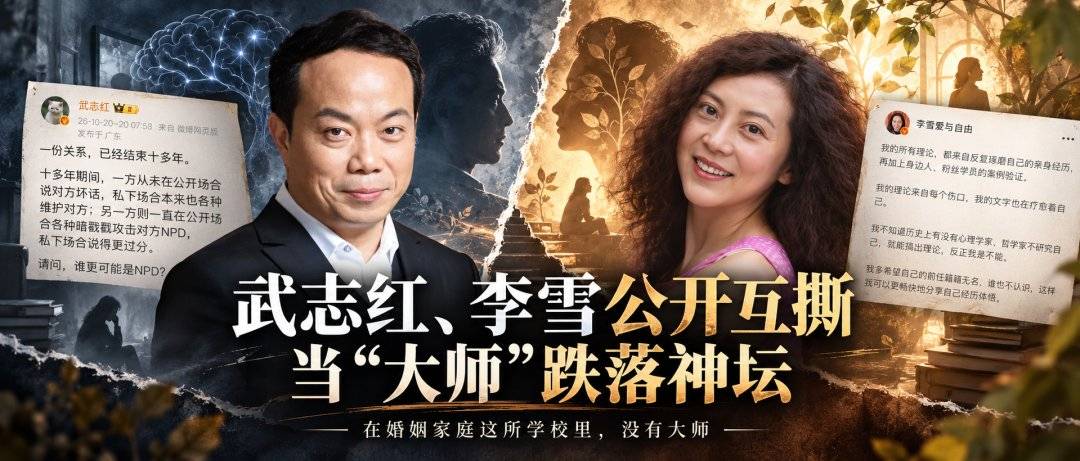
A few deliveries, year-end savings, a 440-square-meter river-view apartment, who helped make whom, and screens full of “NPD”… A relationship that ended more than a decade ago has suddenly been dragged back into the public eye.
One side believes they have long been alluded to through certain articles and psychological concepts; the other responds with a string of remarks that seem complimentary but are actually sarcastic. The dispute moves from psychological viewpoints to household expenses, from old romantic grievances to career contributions. Two people who have spent years studying and teaching about intimate relationships end up, like many ordinary people who cannot let go after a breakup, arguing over the same question: Who really owed whom back then? Who made whom? Who was the more wounded party in this relationship?
What we can currently see consists mainly of Wu Zhihong’s and Li Xue’s public statements on social media. We do not know the full story of this relationship, nor can we judge from this who is telling the complete truth.
But the reason this “drama” sparked heated discussion so quickly may not just be its juicy content, but the sharp contrast brought by the identities of those involved: people who have spent years talking about psychology and intimate relationships — how could their own relationship end up like this?
01 We Love to Deify — and We Love to Watch Them Fall
When a person succeeds, it is easy for others to pile layer upon layer of halo onto them. Everything they say gets applause; ordinary life experience is treated as insight; viewpoints worth discussing are pushed to a position beyond question. Some worship, some flatter, and some stop seriously examining whether what they say makes sense — simply because “this is what the master says.”
Yet once a crack appears in the halo, the onlookers’ attitude quickly turns.
“The master is just so-so.”
“Lectures everyone every day, yet can’t even manage his own life.”
“Knows so much psychology, and still ends up like this in relationships.”
The higher they were praised before, the harsher the mockery tends to be later — as if only by proving “the master is also a joke” can people make up for the loss they felt from once looking up to him.
We simultaneously hope someone will find life’s answers for us, and secretly hope to see them fall from the altar one day.
Deifying a person when they succeed, and completely denying them when something goes wrong, may essentially be the same oversimplification: we refuse to accept that a person can have both contributions and limitations; can be exceptional in some ways and yet handle certain relationships poorly.
02 See Their Limitations, but Don’t Erase Their Contributions
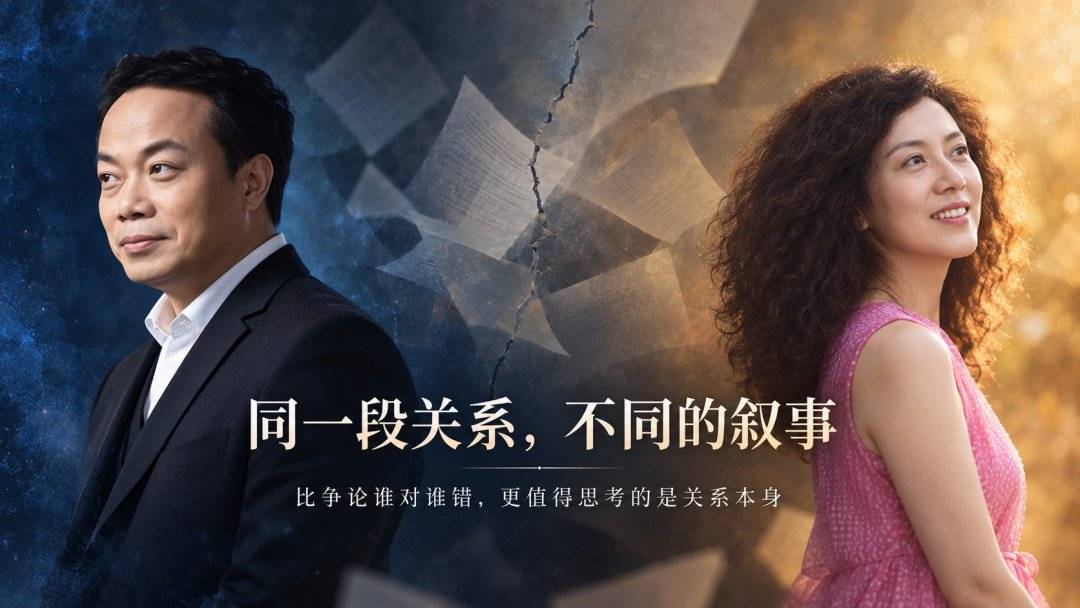
Wu Zhihong and Li Xue have long been engaged in psychology-related writing and outreach. Their works have led many to start paying attention to family of origin, intimate relationships, and self-growth, and have given some feelings that were previously hard to name their first language of expression.
These contributions will not vanish because of a single public dispute.
Likewise, that they once helped others understand relationships does not mean they were always right in their own relationship, nor that they cannot be hurt, angry, out of control, or trapped in their own narratives.
A person’s contributions deserve recognition, and their mistakes can be discussed; acknowledging their limitations does not mean denying their entire value.
Truly mature judgment is not to elevate someone to a god yesterday and stomp them into the mud today, but to see both the help they once brought and the limits they share as ordinary human beings.
03 Understanding Relationships Doesn’t Mean Handling Them Perfectly Every Time
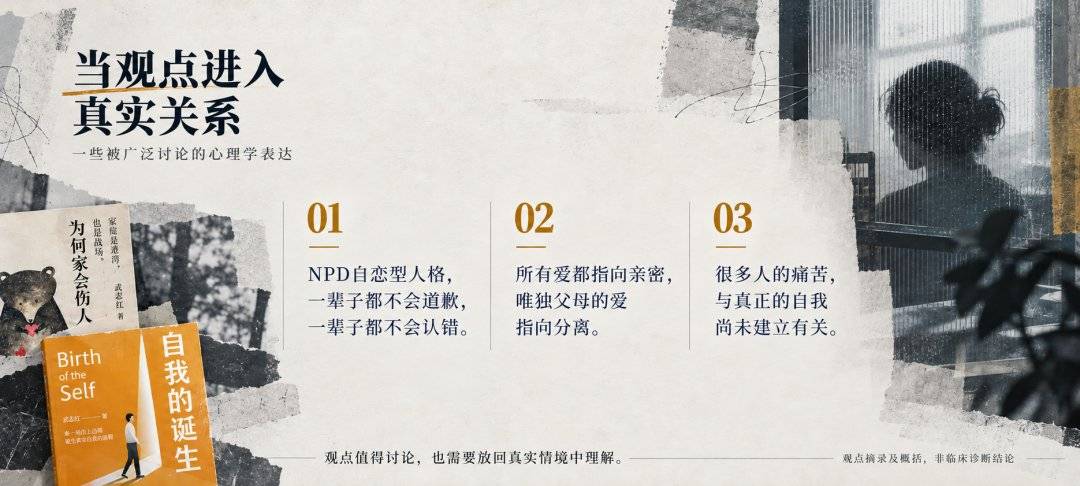
A person can clearly explain attachment, trauma, family of origin, and emotional triggers, yet may not be able to stay clear-headed in the moment they are themselves stung.
Because knowledge addresses: “I know what is happening in this relationship.”
But ability faces: “When it actually happens to me, can I manage my own emotions, hear the other’s feelings, hold our boundaries, and take responsibility for my choices?”
When analyzing others’ relationships, we stand outside; when entering our own, we carry expectations, fears, grievances, and old wounds.
Stating a principle may take only a few minutes; living that principle into a relationship may take a lifetime.
So it is not only psychology experts, but also relationship experts, marriage and family counselors, and everyone who seems to understand relationships well, who may at times be unable to do, unable to see, or unable to get past something in their own marriage and family.
Expertise does not free a person from ever making mistakes. True professionalism is whether, after making a mistake, one can see oneself, take responsibility, and keep learning.
04 In the School of Marriage and Family, There Are No Gurus
This may disappoint some people.
People once believed that someone who understands psychology, marriage and family, and intimate relationships so well should possess a more mature, more perfect relationship.
But marriage and family have never been a place where a person can simply “graduate” by virtue of academic credentials, fame, or professional identity.
Here, there are no always-correct experts, and no masters who need no growth.
Everyone has desires and emotions, their own shortcomings, and moments of being triggered, unable to cope, and needing help. Ordinary people are like this; professionals are no different.
Acknowledging this is not to excuse anyone’s inappropriate expressions. Allowing a person to be imperfect does not mean exempting them from the responsibilities they should bear. The more public influence one has, the more prudent one must be with one’s own expressions, boundaries, and use of professional concepts.
But we also need not lose hope in intimate relationships just because we see their limitations.
On the contrary, this reminds us: the ability to build marriage and family is not something anyone is born with, nor something automatically acquired from a few classes or books. It requires continuous learning, practice, and adjustment in real life, and a willingness to accept help and support when we cannot manage on our own.
So perhaps what is most worth our attention in this dispute is not who won or who lost, nor who is the so-called “NPD.”
But whether we can step back from the onlooking and the mockery, and see a fact again:
Do not idolize anyone’s halo, and do not, because of one person’s limitations, deny the value of learning and growth. In the school of marriage and family, there are no gurus — only students.
We all make mistakes, and we all need to learn; we all have moments we cannot manage, and we can all keep growing.
Learning the capacity to love is a lifelong lesson for everyone!
Appendix: About Hunyin Youdao (婚因有道)
One — About Hunyin Youdao
Hunyin Youdao is a professional organization dedicated to building the service ecosystem for marriage and family. Our mission is: to let everyone enjoy the journey of marriage.
Anchored in the field of marriage and family over the long term, and oriented to the real needs of the marriage and family service industry, Hunyin Youdao continuously advances three pillars — marriage education, professional talent development, and the growth of the marriage service profession — committed to moving marriage services from the experience-based toward professionalization, systematization, and standardization.
Two — Three Major Product and Service Systems
Around the real needs of marriage and family services, Hunyin Youdao has built a systematic set of three major product and service systems.
Marriage Full-Lifecycle Service System
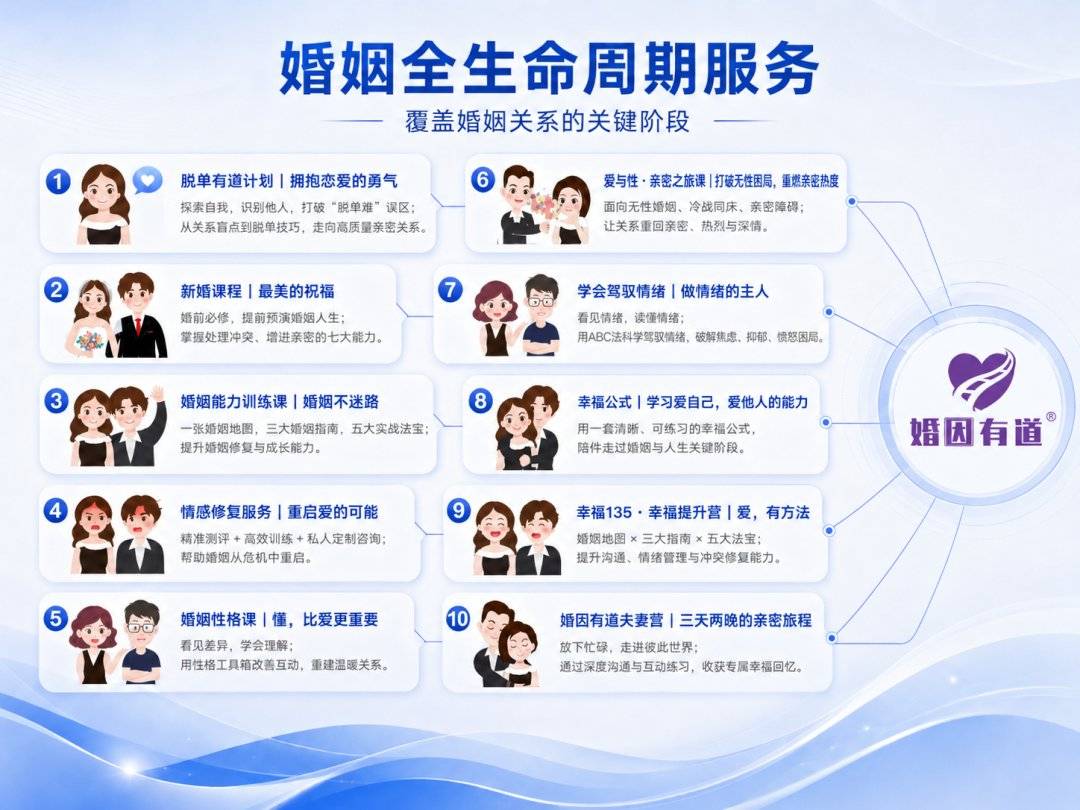
Spanning the key stages of a marriage relationship — dating and mate selection, premarital preparation, post-marital management, relationship repair, sexless marriage, divorce and remarriage — it builds systematic support services.
Through courses, assessments, individual counseling, themed salons, group workshops, specialized boot camps, and professional books, it helps individuals, couples, and families at different stages obtain targeted support.
Our goal is that every key stage of a marriage relationship can receive professional support that is learnable, assessable, accompanied, intervenable, and sustainable.
Marriage and Family Counselor Training System
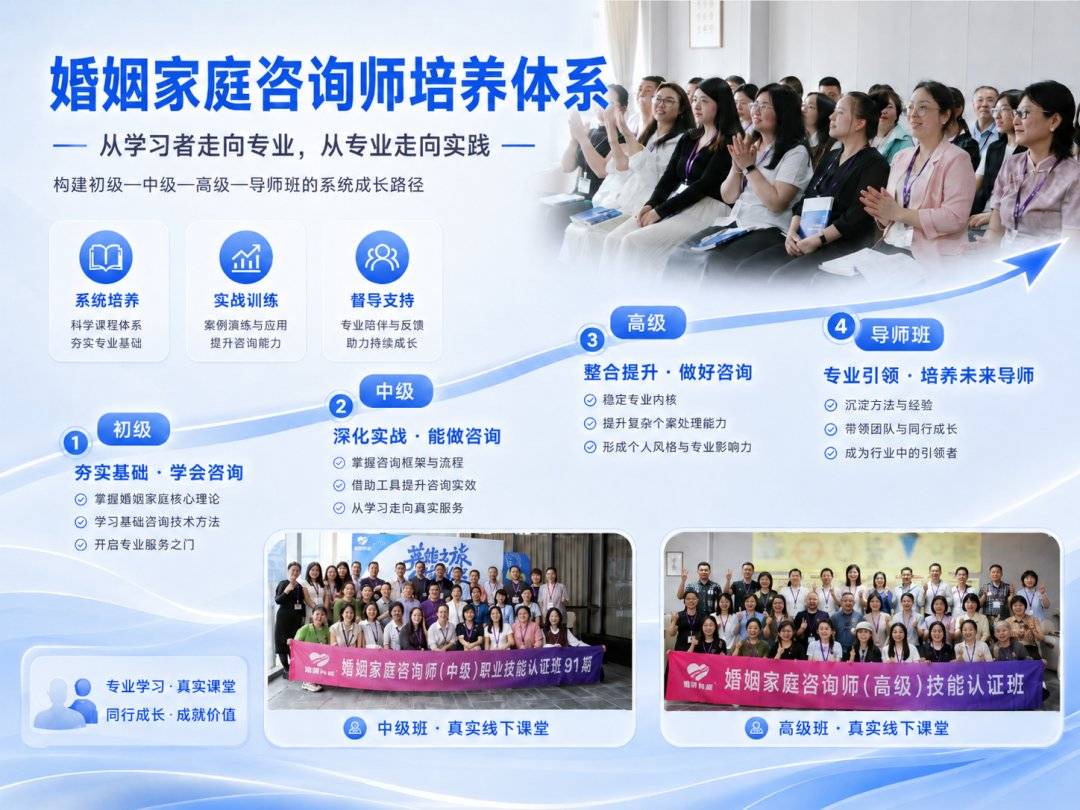
Focusing on the professional growth and career development of marriage and family counselors, Hunyin Youdao has built a systematic training path from introductory, intermediate, and advanced marriage and family counselor levels up to the mentor class, together with professional tool training, supervision support, and career-development support — helping learners achieve continuous growth from learner to professional, and from professional to practitioner.
We help every learner, through sustained learning and practice, grow into a "four-have counselor" — with expertise, capability, income, and dignity.
Marriage Service Career Development System
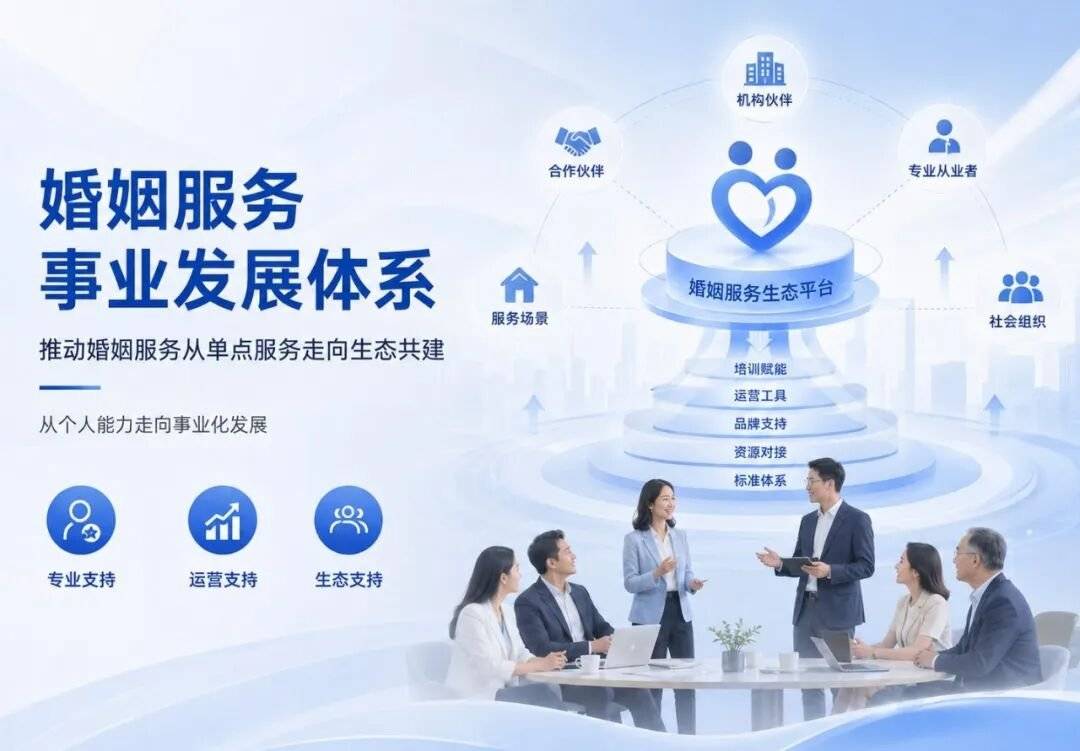
For people and organizations that engage in the marriage and family service profession over the long term, Hunyin Youdao builds a peer-partner support system, providing professional, operational, ecosystem, and platform support, and looks forward to advancing the joint development of the profession together with more partners who have the will, resources, and organizational capacity.
The Marriage Service Career Development System aims to move marriage services from individual capability toward professionalized development, and from point services toward ecosystem co-construction.
Three — From System Building to Practical Implementation: Four Action Paths
The three major product and service systems together form Hunyin Youdao's systematic solution to the needs of marriage and family services. To make this system truly enter industry development, service scenarios, and social practice, Hunyin Youdao continuously advances the implementation and development of marriage and family services along four directions: professional talent, industry standards, multi-party collaboration, and public-welfare action.
Promoting Industry Standardization
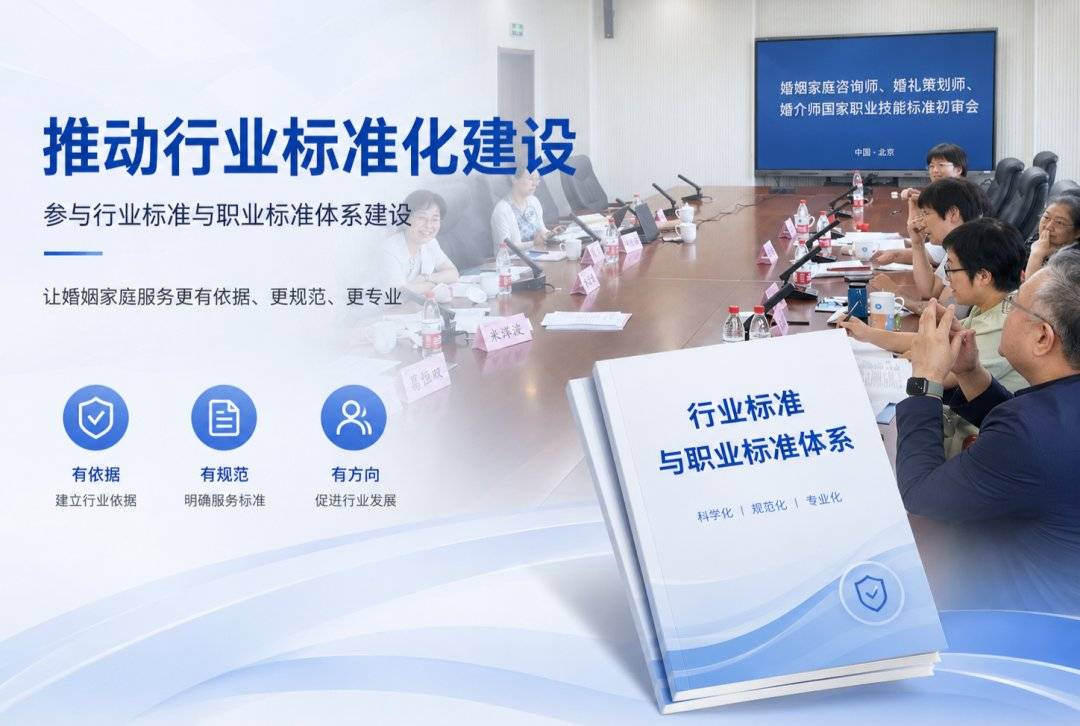
Hunyin Youdao actively participates in building the industry and occupational standard systems for marriage and family services, and drives standards from formulation into practical implementation.
Advancing industry standardization helps establish clearer industry basis, professional norms, and development direction for marriage and family services, and drives marriage services from the empirical toward scientific, professional, and sustainable development — creating a more professional and trustworthy environment for the entire industry.
Building a Professional Talent System
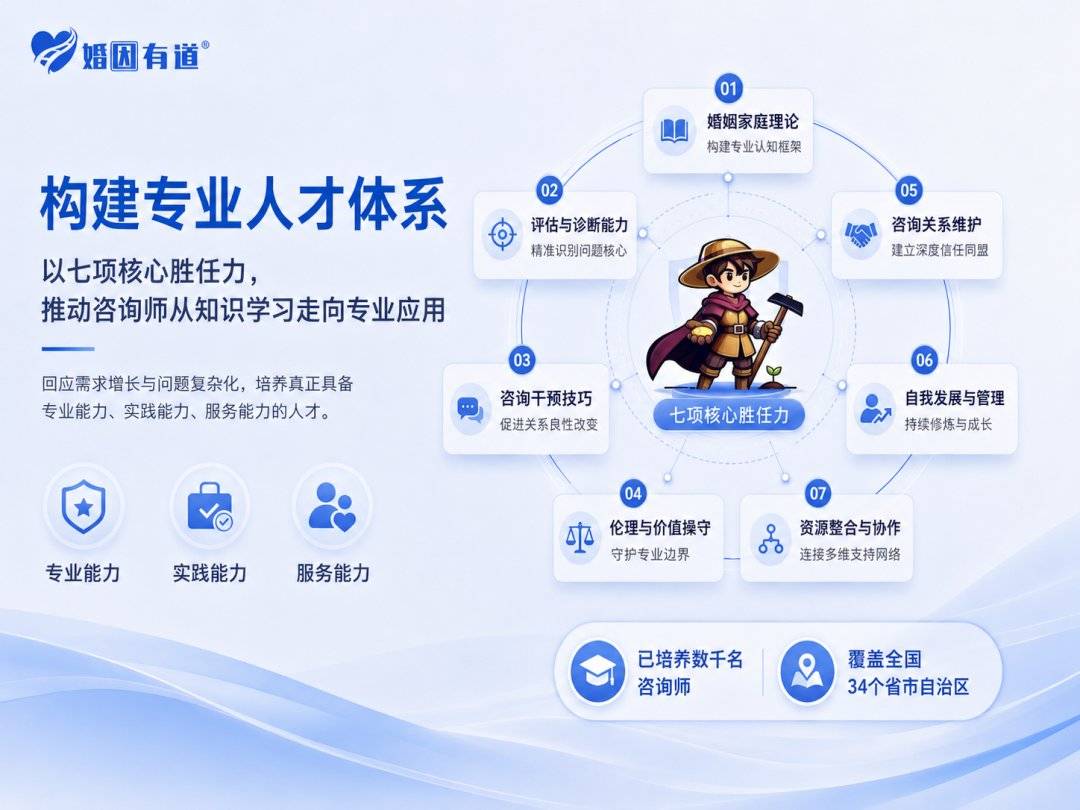
Facing the reality of continuously growing demand for marriage and family services and increasingly complex problem types, the industry needs far more people who genuinely possess professional, practical, and service capabilities.
In response to the industry's problems of "certified but incapable" and "theory only, no practice," Hunyin Youdao proposed the seven core competencies of marriage and family counselors, and built a systematic talent-development framework around them — driving counselors from knowledge learning toward professional application, and from theoretical mastery toward real service.
To date, Hunyin Youdao has trained several thousand marriage and family counselors, active across 34 provinces, municipalities, and autonomous regions nationwide, serving on the front lines of marriage and family guidance, and gradually becoming a professional force advancing industry development.
Driving Multi-Party Collaborative Co-Construction
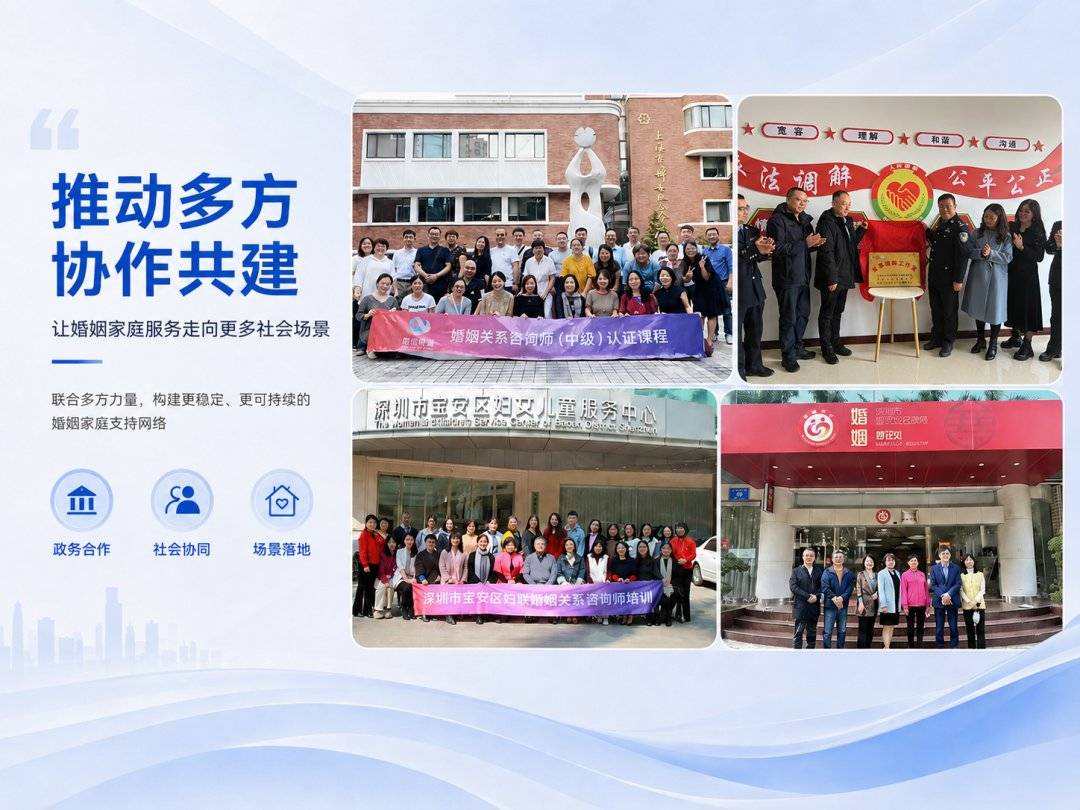
Marriage and family services concern personal happiness, family stability, and social support; they cannot be advanced by a single organization alone, but require the joint participation of government departments, women's federation organizations, enterprises, social organizations, and professional institutions.
Hunyin Youdao continuously drives multi-party collaboration, and has cooperated with civil affairs, women's federations, Communist Youth League, and judicial departments in many regions, as well as with enterprises, social organizations, and professional service institutions — bringing marriage and family services into more scenarios such as marriage registration, grassroots governance, corporate care, and community services.
Through multi-party collaboration, we hope to move marriage services from professional institutions into the social system, forming a more diverse, stable, and sustainable marriage and family support network.
Public Welfare Leading the Construction of a Happiness Ecosystem
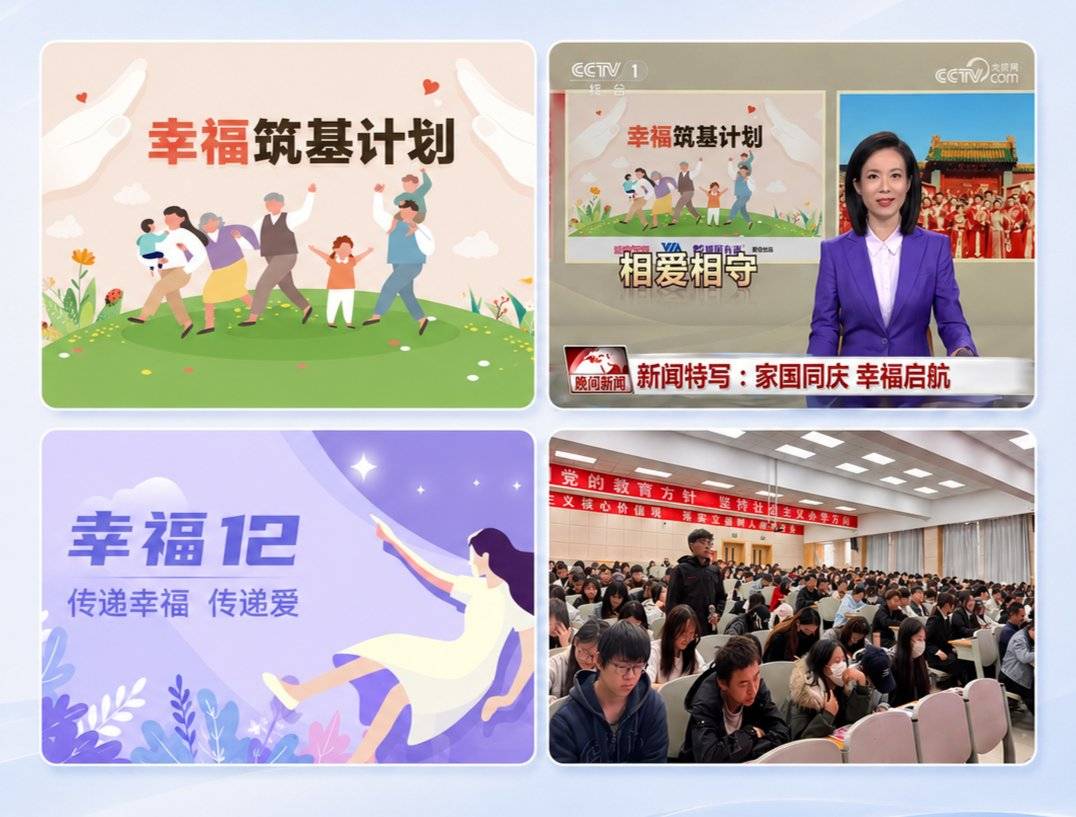
Marital and family happiness requires the joint participation of more social forces. Hunyin Youdao continuously carries out public-welfare projects and social actions, bringing marriage-and-love education and happiness-capability support to broader populations.
We have successively launched public-welfare projects such as the "Happiness Foundation-Laying Plan," the "Happiness 12 Public-Welfare Campaign," the "Hunyin Youdao Salon," and "Love Classes into Universities," with cumulative participation exceeding 1,000,000 person-times.
Through sustained public-welfare action, Hunyin Youdao hopes to move marriage and family services from the professional domain toward social inclusiveness, enabling more people to possess the ability to understand, manage, and repair relationships.
Four — Professionalism Supports Happiness, Action Connects Society
From the three product systems to the four action paths, Hunyin Youdao has always stayed oriented to the real needs of marriage and family services, continuously driving the implementation of professional systems and social practice.
In the future, Hunyin Youdao will continue to support professional services with talent, drive industry development with standards, connect social scenarios with collaboration, and expand social impact with public welfare — making marriage and family services an important force supporting personal growth, family happiness, and social harmony.